Photo: Unsplash
Tokyo’s subway system often looks overwhelming at first.
The maps look complicated, there are many lines, and stations can feel very large at first.
However, once you understand a few basic rules, the Tokyo subway becomes one of the easiest and most reliable ways to travel in the city.
Trains are punctual, signage is clear, and mistakes are easy to recover from.
This guide is written for first-time travelers to Tokyo.
By the end of this article, you will know how to use the Tokyo subway confidently and can prepare for your trip.
Stay connected in Tokyo with an eSIM. Use maps and trains easily during the day.
1. What Is the Tokyo Subway System?
The Tokyo subway system is made up of two main operators:
Together, these two networks cover most of central Tokyo and all major sightseeing areas.
In addition to subways, Tokyo also has many JR lines and private railways.
While these are technically operated by different companies, travelers can use them seamlessly with the same IC card and route apps.
For first-time travelers, it is best to think of all trains and subways as one connected network.
You do not need to remember who operates which line.
If you follow Google Maps and use an IC card, the system works smoothly.
2. Tokyo Metro vs Toei Subway

Photo: Pexels
Do You Need to Know the Difference?
Short answer: No, not as a traveler.
- Tokyo Metro operates more lines and covers much of central Tokyo.
- Toei Subway operates fewer lines, but they connect key areas.
From a traveler’s perspective:
- Routes overlap
- Stations connect underground
- IC cards work on both systems
For most travelers, convenience matters more than knowing the difference.
3. IC Cards (Suica / PASMO): The Easiest Way to Ride
IC cards are the simplest way to use the Tokyo subway.
- Suica and PASMO are prepaid transportation cards
- They work on subways, trains, buses, and even for shopping
- You simply tap in at the gate and tap out when you exit
Why IC cards are recommended
- No need to buy tickets each time
- No need to calculate fares
- Faster entry and exit
Where to get an IC card
- Haneda Airport or Narita Airport (recommended)
- Many large and medium‑size stations
- Mobile versions are available on iPhone (Apple Wallet)
For first-time travelers, IC cards remove almost all complexity.
4. Subway Tickets and Passes
If you do not use an IC card, you can still buy tickets.
Single‑ride tickets
- Purchased at ticket machines inside subway stations
- Fares start from ¥180, depending on distance
- Best for short or occasional trips
- Available at ticket machines at all Tokyo Subway stations
- Fare payments can be adjusted if you decide to get off at a different station
Tokyo Subway Ticket (24 / 48 / 72 Hours)
- Unlimited rides on Tokyo Metro and Toei Subway lines
- Valid for:
- 24-hour ticket: ¥1,000 (adult)
- 48-hour ticket: ¥1,500 (adult)
- 72-hour ticket: ¥2,000 (adult)
- Useful for heavy sightseeing days
- Not valid on JR lines, including Yamanote Line
- Available at ticket machines in many major Tokyo Metro and Toei stations, as well as online
- Official Site
Tokyo Free Ticket (Tokyo 1-Day Ticket)
- Covers Tokyo Metro, Toei Subway, and some JR lines
- Also valid on some buses and other public transport in the designated area
- Costs more, but can make sense for packed itineraries covering many areas
- Fare: ¥1,720 (adult)
- Available at ticket machines at many Tokyo Metro and JR stations
- Official Site
For most first‑time travelers:
- IC card = best all‑around option
- Day passes only make sense if you ride very frequently
5. How to Use Google Maps for the Tokyo Subway

Photo: Pexels
Google Maps is your most important tool in Tokyo.
It tells you:
- Which line to take
- Which platform to use
- Which car to board
- Which exit to take
What to pay attention to
- Line color and name
- Direction (toward which final station)
- Exit number at your destination
You do not need to memorize routes. Just follow Google Maps step by step.
Stay connected in Tokyo with an eSIM and navigate trains with confidence.
6. Station Signs, Platforms, and Route Guidance

Photo: Unsplash
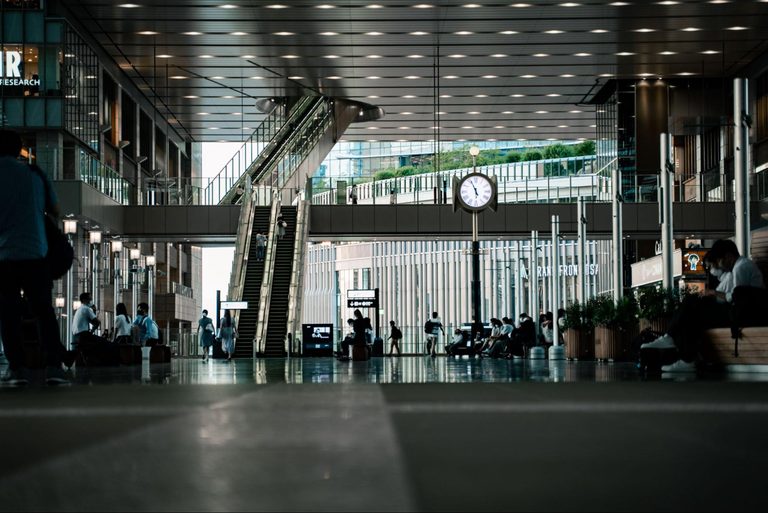
Tokyo subway stations are well signposted and traveler‑friendly.
Most signs are written in Japanese and English, and important information is repeated across walls, floors, and digital screens.
You will commonly see:
- Line names and colors
- Platform numbers
- Train directions (for example, “Bound for Asakusa”)
- Exit numbers and nearby landmarks
The same information is usually shown in multiple formats, so you do not need to rely on listening alone.
Understanding Routes and Directions
Because Tokyo has many train and subway lines, showing multiple routes is completely normal.
There are often several correct ways to reach the same destination.
For example: Shinjuku Station → Nihombashi Station
Google Maps may show:
- A route with one transfer that is slightly faster
- A route with no transfers that takes a little longer
- A route using different subway or JR lines but arriving at the same place
All of these routes are valid.
The route suggestions you see depend on:
- Time of day
- Congestion levels
- Minor delays across the network
When multiple routes are shown, choose the simplest option. Even if you take a different route, you will still arrive safely.
Screens and Announcements
Inside stations and trains, information is repeated clearly.
You will usually see:
- The current station and next station on screens
- The final destination of the train
- Transfer information in English at major stations
Train announcements are made in Japanese and often in English, especially on touristic routes.
If you miss an announcement:
- Platform screens show the same information
- Google Maps confirms your location
Visual guidance is always available, and it is more than enough for navigating the system.
7. Exits and Station Layouts
Large Tokyo stations can have dozens of exits, which often surprises first‑time travelers.
Why are there so many exits in each station?
This happens because:
- Stations stretch across wide underground areas
- Exits connect directly to surrounding streets and buildings
It is very common to:
- Exit a little farther from your destination
- Walk an extra few minutes above ground
This is normal and not a mistake.
If you exit through the “wrong” gate:
- Simply follow Google Maps above ground
- You do not need to re‑enter the station
In Tokyo, choosing the perfect exit is convenient, but not strictly required.
8. Station Facilities You Should Know
Tokyo subway stations are designed to support large numbers of passengers and are generally easy to use.
Most medium and large stations have:
- Elevators and escalators, especially near main exits
- Coin lockers that accept IC cards
- Clean restrooms inside ticket gates
- Convenience stores and small food shops inside stations
If you have luggage, need a restroom break, or want to buy a drink, station facilities are usually available nearby.
Stations are not just transit points. They are designed to support daily travel comfortably.
9. What to Do If Something Goes Wrong
Mistakes happen, even to locals. The Tokyo subway system is designed so problems are easy to fix.
If you miss your stop:
- Get off at the next station
- Take the train back in the opposite direction
If your IC card runs out of balance:
- Use a fare adjustment machine near the exit gates
- Instructions are available in English
If you board the wrong train:
- Exit at the next station
- Check Google Maps again and continue
Station staff are helpful, and you can always show your phone screen if needed.
10. Rush Hours, Last Trains, and Luggage Tips

Photo: Pexels
Rush hours
- Morning: 7:00-9:00 AM
- Evening: 5:00-7:00 PM
Avoid these times with large luggage if possible.
Luggage etiquette
- Large suitcases are fine outside rush hours
- Stand near doors if needed
- If many people are getting off, step out briefly to let them exit smoothly
Most subway and train lines stop running around midnight, so plan evening travel accordingly.
Summary
At first glance, Tokyo’s subway system may look intimidating.
In reality, it is logical, efficient, and highly forgiving.
Remember these key points:
- Use an IC card
- Follow Google Maps
- Do not worry about finding the perfect routes or exits
After just a few rides, confidence comes naturally.